

C2PA Is Going from a “Nice-to-Have” to a “Must-Have” for DAM Systems
For a long time, provenance tracking was a niche concern for photojournalism or rights management. That is changing fast: governance over digital asset origin is becoming a requirement for enterprises, not a bonus feature. DAM vendors that move early on C2PA integration gain a clear edge with enterprise buyers, for whom verifiable asset provenance is now a hard selection criterion. Treating the topic as an afterthought risks falling behind competitors that can reliably show where every asset in their library came from.
What C2PA Actually Does, and Where Its Limits Are
C2PA stands for Coalition for Content Provenance and Authenticity, an open technical standard that cryptographically signs provenance data and binds it directly to the file. Think of it as a nutrition label for digital media: a Content Credential records who created an image, with which tool, and what edits have been made since. Unlike traditional metadata such as EXIF or IPTC, this record cannot simply be removed or faked without invalidating the signature. Camera manufacturers including Sony, Nikon, and Leica are already shipping models with built-in C2PA signatures.
One important caveat: C2PA is not proof of truth. Metadata can be lost during uploads, downloads, screenshots, resizing, or format conversion. A missing Content Credential is not proof that an image is AI-generated or manipulated, only that no provenance data is present. That is exactly why file-level labeling alone is not enough.
Regulatory Pressure: The AI Act Watermarking Duty
Alongside market pressure, regulatory pressure is now building too. Under Article 50(2) of the EU AI Act, providers of generative AI systems must mark their outputs in a machine-readable format and make them recognizable as artificially generated. Systems already on the market before August 2, 2026 get a transition period until December 2, 2026. New systems must comply immediately. These labeling requirements under Article 50 don't just affect DAM systems, they also have very practical implications for online retail, for example for chatbots and product images. Read more in our article on the AI Act in E-Commerce.
Why DAM Systems Become the Central Control Point
This is where digital asset management becomes essential. Because file-embedded metadata can get lost throughout the content lifecycle, relying solely on labeling done by the AI tools themselves is not enough. A central DAM system can systematically track provenance information regardless of whether an embedded credential survives its journey through different tools and platforms. For organizations with growing libraries of AI-generated and human-created content, this layer becomes the real control point for compliance and brand integrity.
How TESSA DAM Already Solves AI Labeling
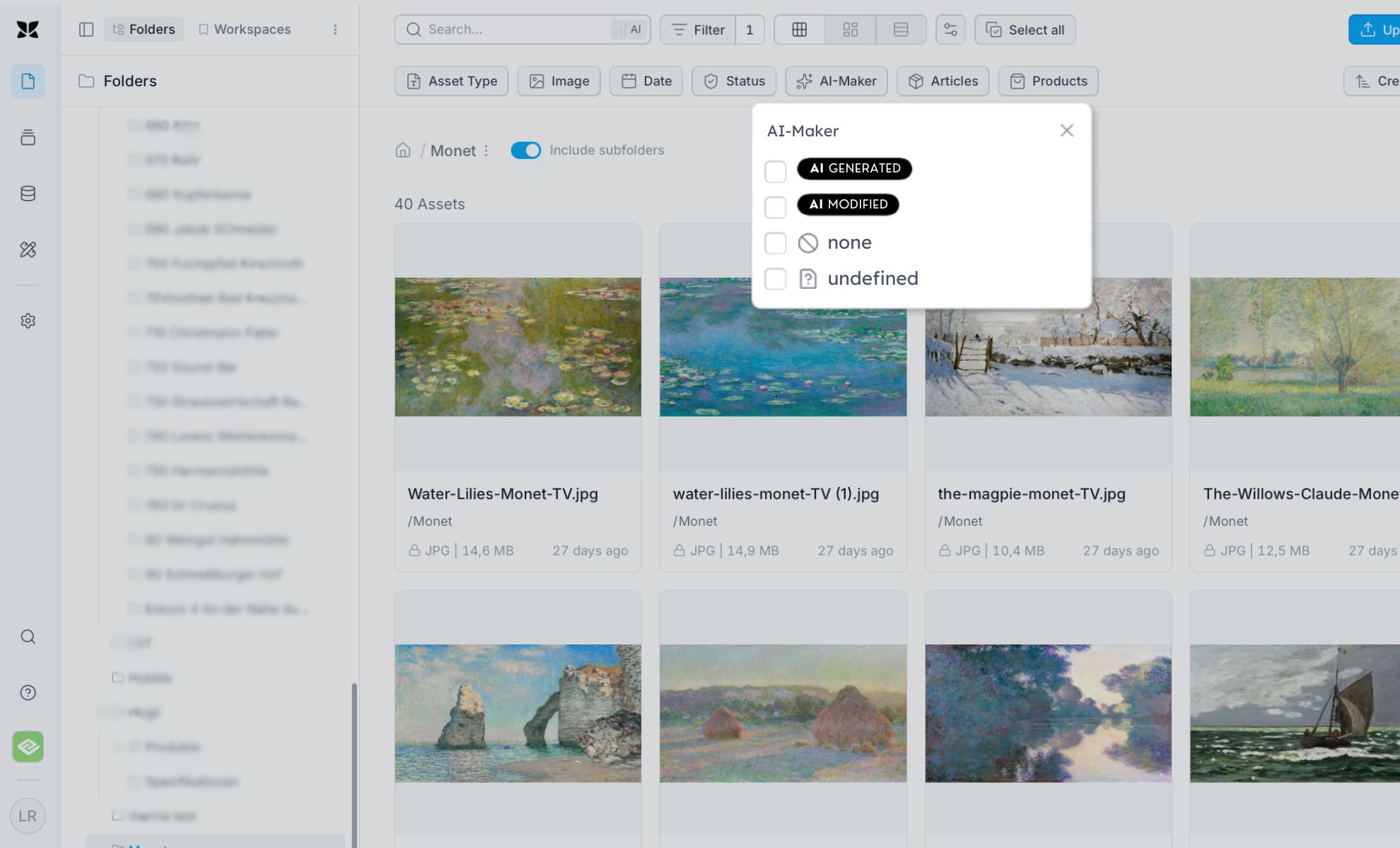
This is exactly where TESSA DAM comes in. When an asset is created or edited with AI, TESSA automatically sets the matching label, AI Generated or AI Modified, and stores it directly in the asset's metadata. The AI-Maker filter can then be used to search and evaluate this labeling. This distinction reflects exactly the direction that both C2PA and the AI Act are heading, where content will increasingly be differentiated between fully AI-generated and AI-assisted material. Organizations already working with this structure won't need to rebuild their DAM from scratch tomorrow. They can carry existing labels forward directly.
Conclusion
Provenance Becomes a Competitive Advantage
C2PA is well on its way to becoming a fixed part of professional content governance, driven by market pressure as much as by regulatory requirements like Article 50 of the AI Act. DAM systems play the central role here, since they can systematically preserve provenance information across the entire content lifecycle. With automatic labeling of AI-generated and AI-modified assets, TESSA DAM is already one step ahead of this development.