

DAM: Costs, Savings Potential, Efficiency Gains & Competitive Advantages
Let's be honest—why does a company invest in new software? In most cases, you're looking for tangible economic benefits. And yes, a digital asset management (DAM) system does come with upfront costs: licenses, service fees, implementation, and internal effort. On the other side of the ledger, though, are substantial savings potential and efficiency gains. A DAM ensures that all your media files can be managed faster and more securely—which isn't just more convenient, but also saves you real money (and headaches) in the long run.
To help you make an informed decision for or against a DAM, let's take a look together at the key economic aspects. In the end, you should know how a DAM pays off in the long term and what competitive advantages it can unlock.
What Does a DAM Cost?
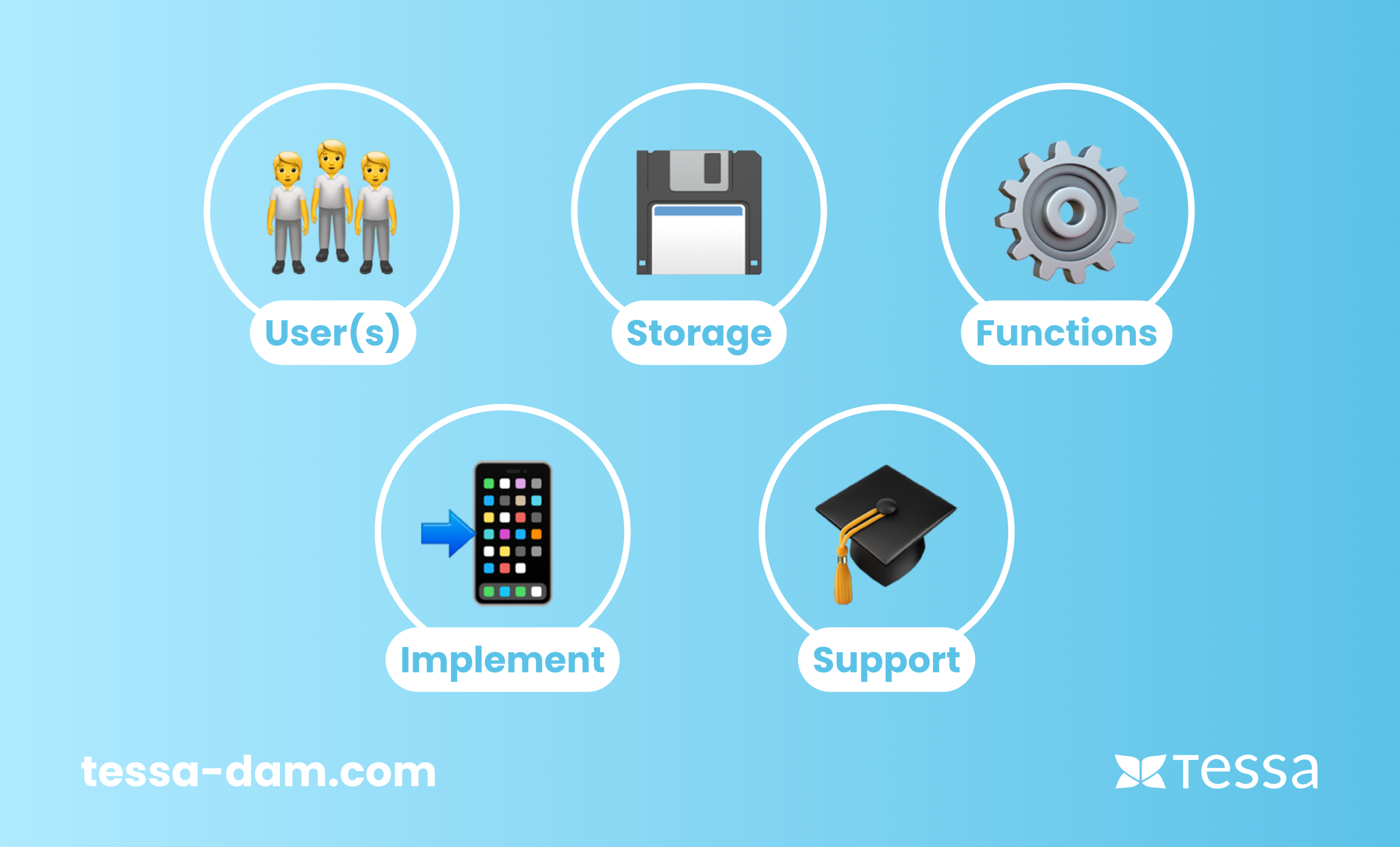
The cost of a DAM system is made up of several components. Which of these weigh most heavily for you depends on your hosting model, team size, and specific requirements. Here are the factors you should keep in mind for any calculation:
On-Premises vs. SaaS
Broadly speaking, there are two deployment types: on-premises and SaaS solutions—and this choice shapes your entire cost structure:
- On-premises: This involves costs for hardware, licenses, and installation. Maintenance or service fees, plus additional costs for customization, are common on top of that. If you choose an on-premises solution, you'll need either an in-house IT department to manage it or an external service provider. In exchange, you avoid ongoing license fees to a vendor.
- SaaS (Software as a Service): With this model, you pay a monthly or annual fee. In return, you don't need to worry about updates, server infrastructure, or maintenance—the vendor handles all of that. Costs are spread out predictably, and there's no major upfront investment in your own servers.
Cost per User per Month
This is worth a closer look: 50 euros per user per month might sound harmless at first. But scaled up to five users, that's already 3,000 euros a year. With our TESSA DAM, all users are included at no extra cost, which can already give you a cost advantage.
Storage Volume
Most plans include a base storage allowance (e.g., 1–2 TB). If you need more, additional fees per TB apply. Figures of 500 to 1,000 euros a year are not unusual here, since this covers not just raw disk costs but also data transfer, backup, and overall operational overhead.
Feature Set
Many DAM vendors tier their offering between basic and add-on features. If you want to connect Photoshop directly to your DAM, for example, or need specific interfaces to third-party systems, this can incur additional license costs. AI features are sometimes included at no extra cost, but can quickly add up if you need, say, large volumes of automated background removal or image optimization.
Implementation Costs
A DAM isn't off-the-shelf software you simply install on your laptop. To unlock its full potential, you need to integrate it into your processes. Consulting, data migration, customization, and custom development typically start around 10,000 euros for smaller projects. For highly complex requirements, this can quickly rise to over 200,000 euros.
Training & Support
Costs also arise here, depending on your team size and specific requirements.
Contract Term & Payment Model
Shorter contract terms offer more flexibility but are often somewhat more expensive per month, while longer terms frequently come with price advantages. The payment rhythm matters too: annual payment is often cheaper than monthly billing with many vendors.
Hidden Costs
Beyond the obvious line items, it's worth looking at costs that often get overlooked: migrating existing assets from legacy systems, custom interface development for third-party systems, and additional training needs if the time included in your package isn't enough. Ask about these points proactively with every quote so you're not caught off guard later.
Granted, a DAM is a bigger investment than, say, standard office software. But it's also far more flexible in adapting to your business processes—and that's exactly what drives substantial savings down the line. It doesn't matter whether you photograph your products yourself or source images from manufacturers as a retailer. A well-implemented DAM pays off in both scenarios.
How to Realistically Budget for a DAM
Before entering pricing discussions with vendors, it helps to get clarity internally on the following points:
- How many users need access today—and how many are likely to in one to two years?
- How large is your current data set, and what growth do you expect (e.g., from new product lines or video content)?
- Which features are non-negotiable for you, and which would be "nice to have"?
- Do you need integrations with existing systems like PIM, ERP, or e-commerce platforms?
- Do you prefer cloud hosting or an on-premises solution—and why?
- How much budget is available for implementation, training, and ongoing support?
With these answers in hand, you can request quotes more precisely and compare them far more effectively, since you'll know exactly what you need and where you might have room to negotiate.
What Savings Potential Does a DAM Offer?
To give you a realistic sense of scale, here are a few examples. Exact figures naturally vary case by case, but these are the key points to keep in mind:
- Time savings
Who wants to waste 20 minutes a day hunting through file chaos for the right image? If 50 employees work this way, that's the equivalent of roughly two full-time positions (FTEs) tied up purely in searching. A DAM can massively reduce this burden. - Reduced costs for re-creating assets
Few things are more frustrating than redoing a photoshoot or repurchasing an image simply because the original file can't be found or is damaged. A DAM guarantees you access to your assets in the best quality at all times. You can expect to save around 1/5 to 1/4 of your previous spend in this area. - Optimized storage costs
While a DAM does involve storage costs, automatically avoiding duplicates reduces them over the medium to long term. A realistic savings range is 10 to 15 percent. And by cutting down on redundant data, you're also doing something good for the environment—a positive, if hard-to-quantify, side effect. - Personnel savings
Sure, filing assets into a DAM can be more work upfront, since each asset needs to be properly tagged and entered. But you'll get that time back many times over later, when it comes to finding, processing, and distributing your files. Overall, you can expect a net time savings of around 20 percent. - License management
If you work with models, advertising partners, or use award seals, you know the challenge of time- or scope-limited usage rights. A DAM can automatically warn you before licenses expire, helping you avoid costly contract violations. If you've had penalty payments in the past, you can expect to cut those by at least half. - Reduced sales costs
In short: when you can respond to inquiries quickly, thoroughly, and with high-quality media, you save time and therefore money. You can reasonably expect around 20 percent less effort in your sales department. There's also a positive effect on revenue, since you deliver high-quality material faster, boosting your conversion rate.
What Revenue Potential Does a DAM Offer?
A DAM isn't just a strong case on the cost side—it can also give your revenue a real boost:
Supplying more retailers with better quality
Especially in e-commerce, fast and reliable delivery of high-quality assets is a decisive competitive advantage. No one likes waiting forever for images or videos. And if you, as a supplier, deliver quickly, you make yourself indispensable to your retailers. Exactly how much your revenue increases depends on your market and negotiating position, of course. But nearly every industry sees a noticeable uplift.
Customer satisfaction through more consistent presentation
When your brand messaging is presented consistently and at a high standard, customer satisfaction naturally increases. This shows up both in better conversion rates and in customer loyalty. In short: people who buy from you once are more likely to come back.
Quality Improvement and Employee Satisfaction
Don't forget the "soft" factors that are often only indirectly measurable in dollars and cents. A well-implemented DAM typically means less day-to-day stress, faster results, and higher satisfaction across your teams. Granted, rolling out such a system can initially spark discussions, require training, and establish new processes. But once the DAM is up and running, your colleagues will wonder how they ever managed without it.
Conclusion
In the end, it all pays off
A DAM is definitely not a bargain-bin purchase. It requires a willingness to invest and a certain openness to change within the company. But the benefits are substantial: less searching, more productivity, better data quality, lower licensing risk, and, on top of that, satisfied teams who can focus on genuinely valuable work instead of spending forever in file chaos.
If you plan your DAM carefully, implement it professionally, and bring everyone along, you'll quickly see that this investment pays off—not just in pure cost savings, but also through higher revenue and a stronger market position. And the best part: rolling out a DAM can even be enjoyable, especially once you start seeing the time savings and improved overview in your processes.
So go ahead and take on the topic of DAM. We're happy to help you find the right solution and implement it successfully. After that, you definitely won't want to go without your digital asset management again. Feel free to also check out our TESSA DAM pricing and plans.