

Brands today communicate across a growing number of channels – internally, with partners, in retail, and in the public arena. To ensure the right content in the right version is used everywhere, companies need a central point of access for all brand-related resources. That is precisely what a brand portal is: a digital platform where all brand content is bundled, managed, and made available in a controlled manner.
What is a Brand Portal?
A brand portal is a web-based platform that serves as the single source of truth for all content and guidelines belonging to a brand. Employees, agencies, retailers, and other external partners find everything they need there to represent the brand consistently and correctly: logos in approved variants, color palettes, typefaces, imagery, communication guidelines, and ready-to-use templates. A brand portal replaces decentralized folder structures, email attachments, and manual requests, creating instead a structured, always-accessible self-service area for everyone involved with the brand.
The term is often used interchangeably with related concepts in the market. Brand hub, media portal, or press portal describe essentially the same idea, though they sometimes differ in scope: while a basic brand portal primarily provides guidelines and static files, modern brand portals additionally offer dynamic output formats, role-based access management, and direct integration with a Digital Asset Management system.
What Content Belongs in a Brand Portal?
What a brand portal concretely contains depends on the brand and its requirements. Typically, however, all elements of the corporate identity necessary for consistent brand representation are stored there. This includes the logo in various formats and color variants, defined brand colors with exact color values, approved typefaces, and design rules for all relevant communication materials. This is complemented by released imagery such as product photos, lifestyle shots, and icons, as well as templates for presentations, social media formats, or advertising materials.
For companies with a broad product portfolio, structured product data and associated media also flow into the brand portal. In this case, the functions of a brand portal merge with those of a media or product portal: partners receive not only the brand world, but also current product images and information directly from the source – without detours through internal departments or manual file transfers.
Why Do Companies Need a Brand Portal?
Without a central platform, problems quickly arise in practice: files are used in different versions, logos appear in incorrect colors, and agencies work with outdated templates. Each of these inconsistencies weakens the external perception of the brand and can erode trust in it over time. A brand portal solves this problem by creating a single, authoritative location from which all brand stakeholders access content – always the current version.
Another key advantage is efficiency. Marketing teams, sales, retailers, and external service providers can independently find, download, and retrieve the assets they need in the desired formats, without having to submit an internal request each time. This significantly reduces administrative effort and accelerates campaigns, product launches, and sales processes. Through granular user rights and role management, it is possible to precisely control who has access to which content – whether internally or for external partners with restricted access.
How Does a Brand Portal Differ from a DAM System?
A Digital Asset Management system and a brand portal pursue related but distinct purposes. The DAM is the operational core: this is where digital assets are centrally stored, tagged, versioned, edited, and managed. It is primarily aimed at internal teams who work daily with large volumes of media files.
A brand portal, on the other hand, is more focused on output and distribution. It is often the outward-facing frontend of a DAM system: curated, clearly designed, and structured so that even users without deep system knowledge can quickly find the right asset. In many modern setups, both systems are directly linked – the DAM supplies and keeps assets current, while the brand portal makes them available in a prepared, user-friendly form. This combination ensures that approved content becomes automatically available without anyone needing to manually transfer or update files.
Who Benefits Most from a Brand Portal?
Brand portals are particularly valuable for companies that work with many external partners – such as retailers, agencies, franchisees, or international subsidiaries. Wherever brand content regularly needs to be shared with third parties, the absence of a central solution quickly creates significant coordination overhead. But internal teams benefit just as much: when marketing, sales, PR, and product management all access the same platform, the risk of different departments working with different versions of the same logo or image is substantially reduced.
Particularly in industries with high brand pressure – such as consumer goods, fashion, or medical technology – consistent brand representation is not only a matter of appearance but also of compliance. A brand portal creates the necessary binding framework here by clearly defining which assets are approved and which are no longer permitted for use.
What is TESSA BrandHub?
BrandHub is EIKONA Media's brand portal solution, combining the functions of a brand portal, media portal, and product portal in a single platform. BrandHub builds directly on TESSA DAM: assets that are managed and approved in the DAM are automatically available in BrandHub – always current, always in the approved version. With a configurable homepage layout, custom colors, and the company's own logo, BrandHub can be operated entirely in the brand's own corporate design.
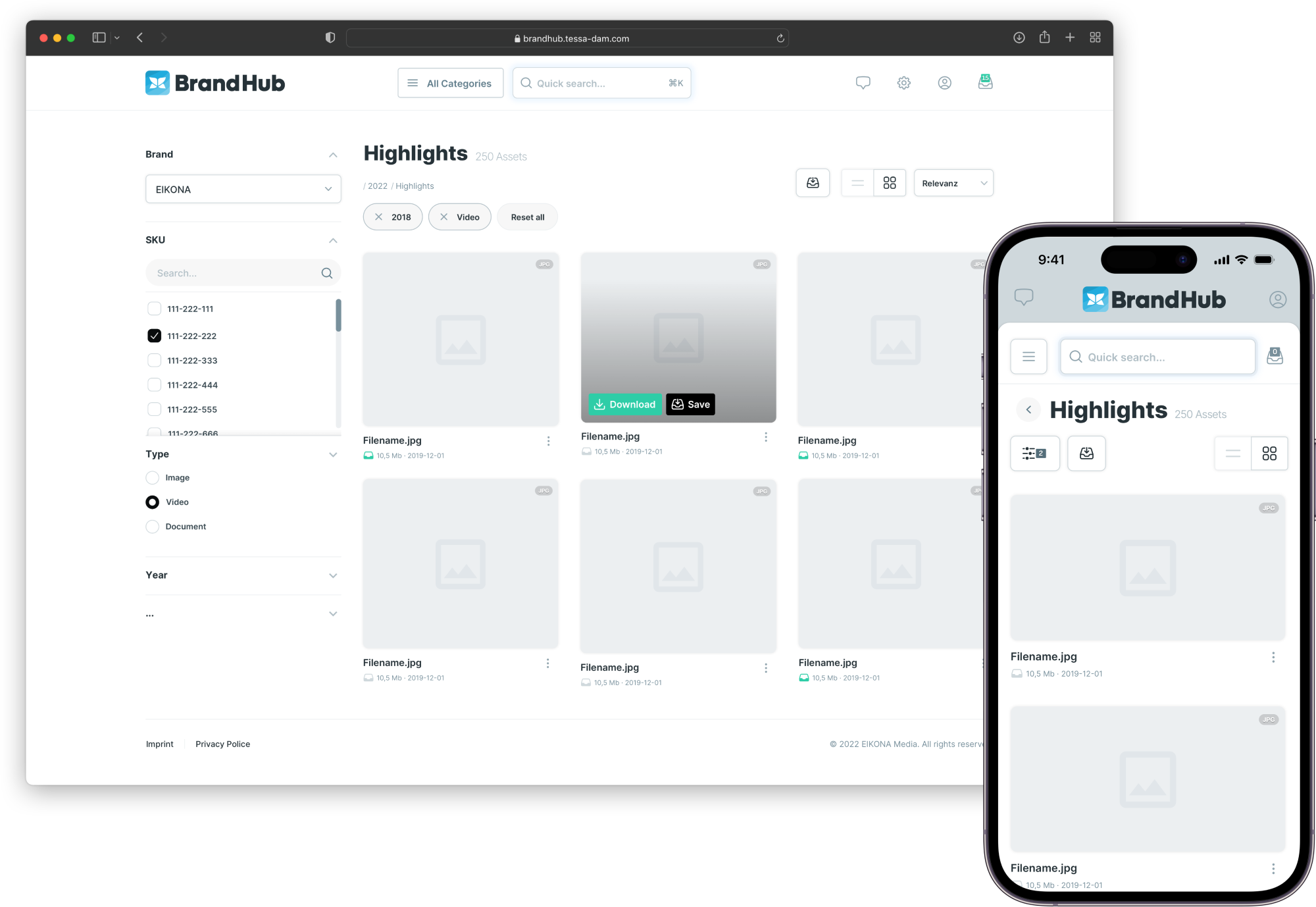
Retailers, agencies, and partners can log in independently, search for assets, download product images, and retrieve content in the required formats – without having to submit an internal request each time. Granular user rights management ensures that every user can only access the content that has been released for them. BrandHub is therefore one of the most efficient answers to the question of how brands can distribute their content externally in a scalable, consistent, and controlled manner.
Conclusion
Brand Portals as the Foundation of Consistent Brand Communication
A brand portal is far more than a digital storage system for logos. It is the organizational and technical foundation for ensuring that a brand appears consistently and recognizably everywhere – internally and externally, nationally and internationally. The larger the company, the more partners and channels are involved, the more important such a central platform becomes. Combined with a powerful DAM system, a seamless workflow emerges: from the creation and approval of an asset to its targeted provision for exactly the people who need it. With TESSA BrandHub, companies have a solution that meets precisely this requirement – as a brand, media, and product portal in one.


