

What exactly is a PIM system?
A PIM system is the central tool for product data management and helps organize all product-related information – attributes such as colors and weights, various texts (for example product descriptions in multiple languages and lengths), and categories and assortments.
The information flows from upstream systems such as ERP systems into the PIM, where it is enriched and unified. These refined contents, often complemented by digital assets from DAM systems (Digital Asset Management), are then made available for catalogs, websites, e-commerce platforms, and data handover to retail. Technically, a PIM is often based on an SQL database that reliably handles large volumes of data.
Why do companies need a PIM system?
As soon as companies manage information for many products, building a consistent information structure becomes a real challenge – for manufacturers and retailers alike. A PIM solves exactly this and creates the basis for consistent, high-quality product data across all channels.
Retailers can achieve homogeneous data quality across all suppliers and product classes. Manufacturers consolidate data from various sources, control its quality, and build an optimal basis for omnichannel commerce. At the same time, the PIM is the foundation for translation into any language and therefore a starting point for internationalization. Attribute data, texts, and categories can also be delivered to customers and partners in tailored assortments. This makes PIM systems an essential prerequisite for platform business – and a relevant competitive factor that secures competitiveness and enables revenue growth.
How does the PIM process work?
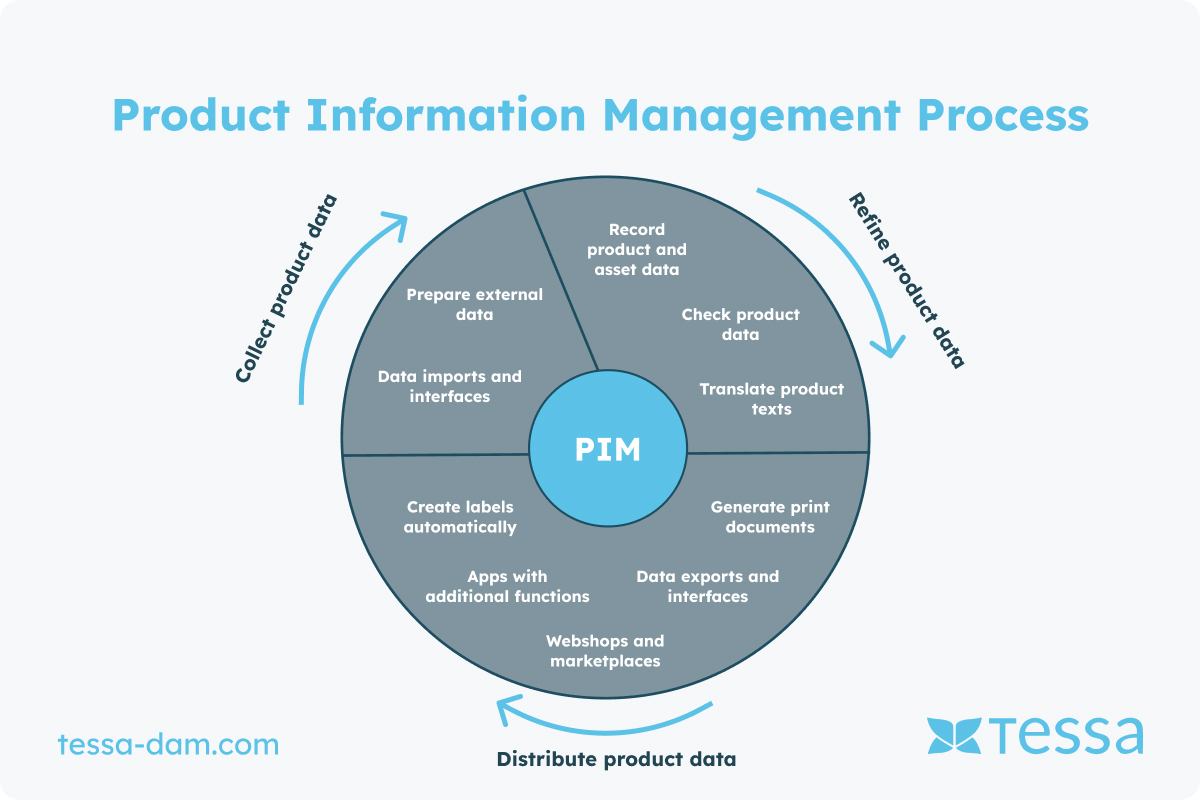
The PIM process, also called the product lifecycle, consists of several connected steps with one goal: to create, manage, and distribute high-quality, consistent product information.
- Data import: Product information is imported from various sources – suppliers, manufacturers, and internal systems – ensuring central capture of all relevant data.
- Cleansing and harmonization: Imported data is checked for quality, cleaned, and standardized into a uniform format, including the unification of attributes and categories.
- Enrichment: Additional information such as descriptions, images, technical data, and marketing texts completes and improves the product information.
- Classification and taxonomy: Products are organized into categories and classifications for a consistent structure and easier search and access.
- Translation: When needed, product information is translated into multiple languages to support international marketing.
- Quality control: A thorough review ensures all product information is accurate, consistent, and up to date.
- Release: Approval and release processes ensure that only reviewed, authorized information is published.
- Publication: Product information is exported to various sales channels – e-commerce sites, catalogs, mobile apps, and more.
- Monitoring and updating: The process is continuously monitored and updated as needed to keep product information accurate and relevant.
Designed this way, the PIM process increases efficiency and ensures a consistent presentation across all sales channels. The exact setup varies with each company's requirements and product types.
PIM, ERP, DAM, MDM, and PXM – what are the differences?
A PIM is often confused with related systems but fulfills a clearly defined task: managing sales- and marketing-relevant product information. The key distinctions:
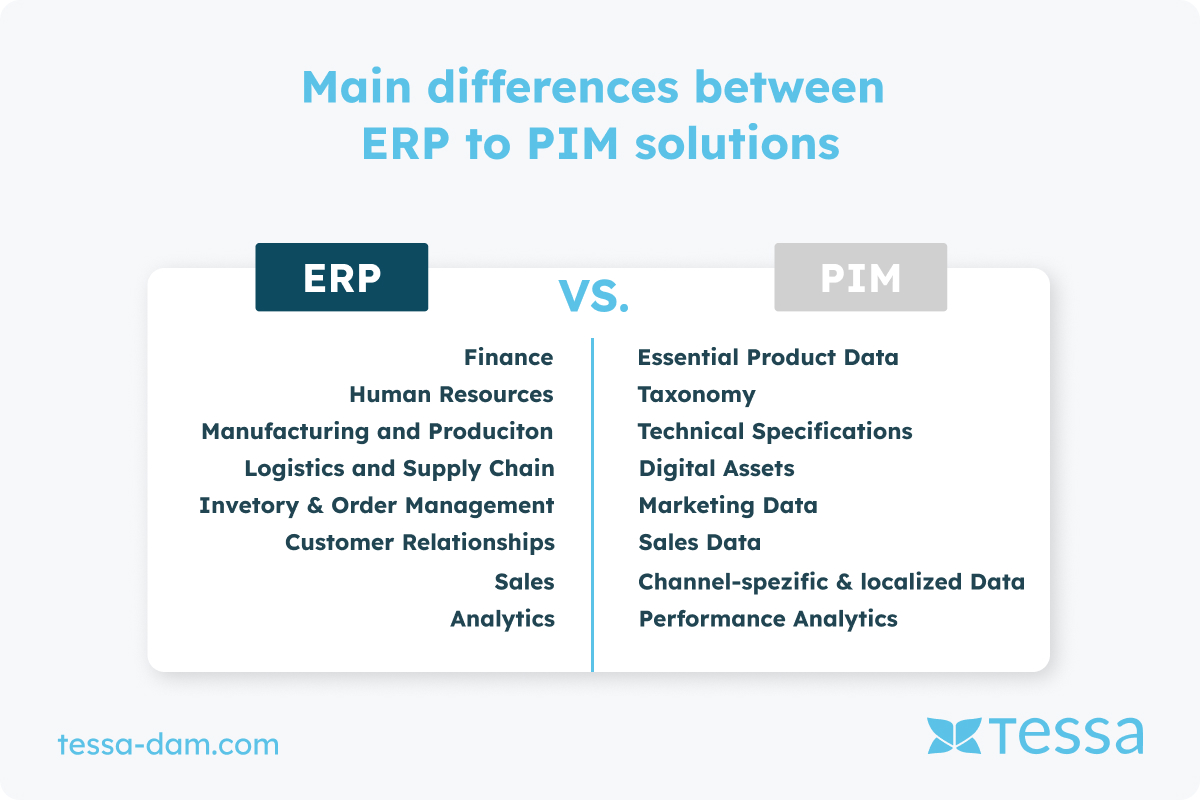
- PIM vs. ERP: An ERP system runs business processes such as finance, logistics, and warehousing and supplies technical master data (weights, dimensions). A PIM takes that data and enriches it with marketable information. In short: ERP for internal operations, PIM for external presentation.
- PIM vs. DAM: A DAM system manages media assets such as images, videos, and documents; a PIM manages descriptive product data. In practice they complement each other – the PIM links products to the matching assets in the DAM.
- PIM vs. MDM: Master Data Management handles company-wide master data across all domains (customers, suppliers, employees). A PIM specializes in the product domain and can be part of a broader MDM strategy.
- PIM vs. PXM: Product Experience Management (PXM) builds on a PIM and focuses on the channel- and context-specific, personalized delivery of product content.
Who benefits from a PIM system?
A wide range of market players benefit from a PIM system – from manufacturers and retail to marketing and sales teams. What they share is the gain in consistent, high-quality product information.
- Retailers and e-commerce businesses deliver product data consistently and at high quality across all channels, improving the customer experience and the efficiency of publishing.
- Manufacturers and suppliers integrate product information from sources such as ERP systems, centralize and standardize it, and ensure a unified, detailed presentation for B2B and B2C sales.
- Brand owners secure consistent brand communication and improve product visibility.
- Marketing teams access a central platform of current, complete, and on-brand product information for campaigns and multichannel strategies.
- Purchasing and sales teams keep track of supplier information and catalogs and serve customers based on accurate data.
- Internationally active companies benefit from flexible access plus support for translation and regional adaptation, strengthening market presence.
Ultimately, end customers also enjoy a better shopping experience thanks to accurate, comprehensive, and engaging product information.
Where is PIM used?
PIM is used wherever product information needs to be managed efficiently – across industries and channels. The main areas:
- E-commerce: consistent presentation of product data across online shops and platforms.
- Retail and trade: central organization of product information for stores, online shops, and catalogs.
- Manufacturing and industry: management of complex product data including technical specifications and bills of materials (BOM).
- Marketing and advertising: efficient creation and distribution of materials based on high-quality, consistent product data.
- Multichannel marketing: uniform product information across print, online, mobile, and social media.
- Publishing: optimized management of texts, images, and content for printed and digital publications.
- Global markets: management and adaptation of product information in multiple languages and for different markets.
- B2B sales: organization and delivery of complex product information for business customers.
Which systems does a PIM work with?
A PIM is rarely a standalone solution; it is part of a system landscape that pulls data from upstream systems and forwards it to output channels. Product data can be entered directly in the PIM, but in most cases it is captured in upstream systems first.
Retailers usually request data as CSV or Excel files from their suppliers and define a fixed attribute set. This allows many products to be displayed quickly in their own online shop. There are also interfaces for importing from standard formats – examples include ETIM, common in the electrical industry, and the cross-industry eClass and proficlass for parametric methods.
Manufacturers often use PLM systems (Product Lifecycle Management) that collect all economically relevant information from the product idea onward – from market potential to supplier quotes and sales figures. This PLM data is usually not sufficient on its own: morphological data from the operational software (ERP) must be added, such as gross weights, dimensions, and packaging units.
Also essential are DAM systems like TESSA DAM, which link assets – images, drawings, documents, and other files – to products. For data output, a PIM works with integration software such as Lobster or Synesty and passes data to e-commerce systems or to solutions for automated catalog publishing.
Which PIM solutions are available?
The market for PIM solutions is large and hard to navigate – the PIM directory alone lists well over 90 solutions. Broadly, they fall into on-premise and cloud solutions, depending on whether the software runs in your own facilities or in the cloud. The most common professional setup today is a dedicated server in the cloud.
Systems rated particularly well by users on OMR Reviews include:
In our assessment, Akeneo is the most widely used professional system – available as an open-source community edition and as a professionally managed version. TESSA DAM connects to Akeneo via a dedicated interface. Pimcore is similar and offers an open-source solution with additional services. Informatica and SAP provide enterprise solutions.
Is SAP a PIM system?
No, SAP is not a traditional PIM system but a comprehensive ERP solution (Enterprise Resource Planning) that covers business processes from finance and logistics to HR. SAP offers basic product data management but is not designed to centrally manage and deliver detailed product information across multiple sales channels the way a PIM does.
ERP systems like SAP coordinate operational processes – order processing, inventory management, financial accounting. A PIM, in contrast, manages and distributes detailed, marketing-relevant product information and offers dedicated functions such as enrichment, translation, and classification. Some companies extend their SAP system with additional modules, but this often requires significant customization. For most companies, a specialized PIM is more efficient, as it integrates seamlessly with ERP systems like SAP.
How much does a PIM system cost?
PIM costs vary considerably – from free open-source solutions to tools from enterprise vendors such as SAP or Informatica. As with many software products, they consist of several components:
- setup costs
- annual costs for server operation
- costs based on the number of accounts (people working in the system)
- costs based on the number of products (SKUs)
- modules or interfaces that may be charged separately
On top of this come costs for customization and updates, as well as the staff effort required to maintain product data and operate the system.
Conclusion
Managing product data efficiently and consistently
A PIM system is essential for companies that want to manage and use their product data efficiently and consistently across all sales channels. By centralizing and enriching product information, a PIM enables not only better data quality but also faster, more flexible delivery of content for national and international markets. In this way, Product Information Management makes a decisive contribution to competitiveness and customer satisfaction and forms the basis for successful multichannel marketing and international expansion.


